Entries
Sunday, 29 April 2007
Health Post: SARSThe processes which are intensifying human interaction across boundaries of nations, time and ideas in economic, health and environment, society and culture, knowledge and technology and political and institutional spheres. –Kelley Lee’s definition on Globalisation
Can be regarded as a second industrial revolution, affecting all sectors of society
–Clare Short’s definition on Globalisation
Globalization of travel, food production and environmental degradation is increasing the threat from infectious diseases, old and new as Kelley Lee has stated. Historically, the worldwide spread of infectious diseases has coincided closely with a gradual process of globalization over many centuries. This implies that health issues have been raised as an effect of globalisation due to the spread of diseases across barriers of space, time and culture. In terms of health, globalization has both helped to spread some of the deadliest infectious diseases known to humans, yet also reshaped the social geography within which humanity strives to create health or prevent disease, from Wikipedia. Some of the most acknowledged international diseases are plague, measles, small pox, malaria, tuberculosis and HIV/AIDS, and one of the most recent diseases in the world is SARS. In this post, the issue of SARS, will be discussed to show the effect of globalization on the aspect of health.
 http://en.wikipedia.org/wiki/SARS
:
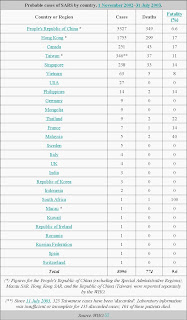
Severe acute respiratory syndrome or SARS is a respiratory disease in humans which is caused by the SARS coronavirus. There has been one major epidemic to date, between November 2002 and July 2003, with 8,096 known cases of the disease, and 774 deaths (a mortality rate of 9.6%) being listed in the WHO's April 21, 2004 concluding report.
As we can see from the above table and diagrams, the transmission of SARS epidemic took place in Toronto, Singapore, Taiwan, Canada, several provinces in China, and many other countries, making it an international disease. Although only a small number of people with SARS can become severely ill, it is one of the most focused diseases in several countries such as Canada and China, and international organizations such as World Health Organization (WHO).
It is also “well-known” diseases in Singapore and has detrimental effect on Singaporeans during the peak of the disease. This can be seen from the numerous establishments of precautionary measures such as quarantines, screening and temperature-checking by the Singapore government to control the spread of SARS in Singapore. This is due to the fact that the illness is believed to spread from coughing and sneezing or from direct face-to-face contact with a person who has SARS.
From
http://www.mja.com.au/public/issues/180_04_160204/lee10732_fm.html:
As Ruggie writes,
Globalisation does not come in tidy sectoral or geographically demarcated packages. It is all about interconnections — among people; across states, in production networks and financial markets; between greed and grievance; among failing states, terrorism, and criminal networks; between nature and society. The complex interrelatedness of issues and their cumulative, often unforeseen, consequences demand far greater policy coherence than the existing system of national and international institutions has been able to muster.Hence, from this issue, we can see that the effect of globalization in the epidemic of SARS is a negative one as the disease can be spread easily due to intimate physical contact between human beings, and the increase in transportation connectivity due to globalization has increased the rate at which SARS can be spread. Thus the epidemic of SARS has shown us a clear view of the disadvantage of globalization in the aspect of health in this case.
RONG QI Signing Off
- because there's really no need to, anymore...
7:37:00 pm